Self-employment tax explained: the 15.3% rate, who pays and how to estimate it
Quick answer
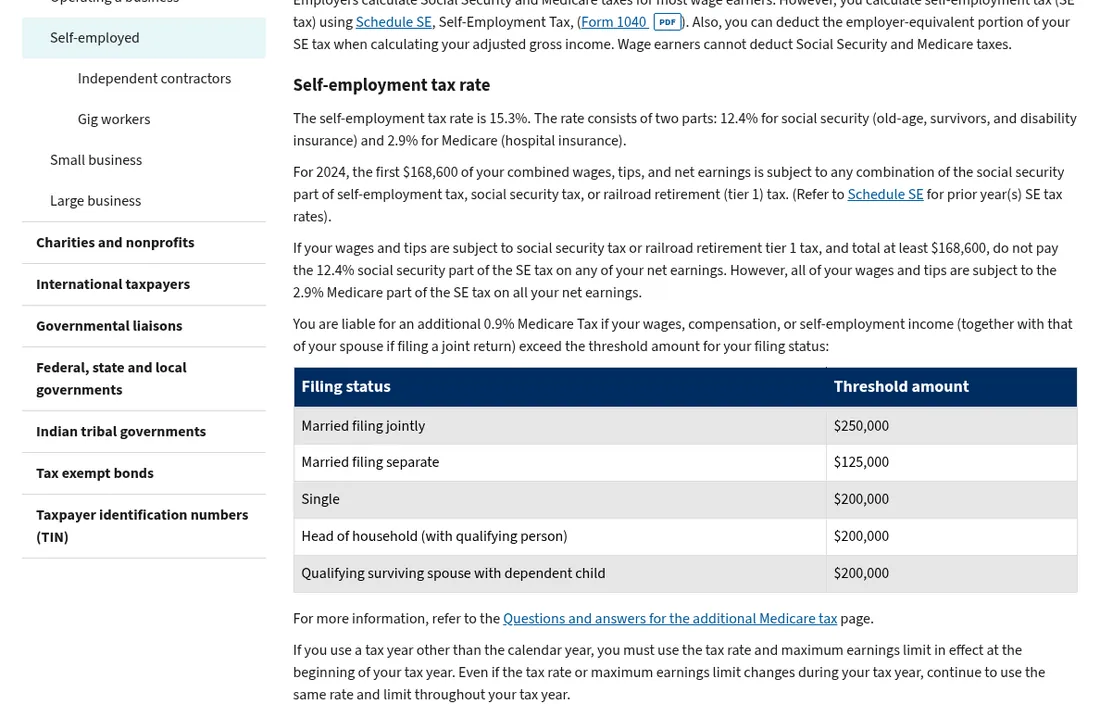
Self-employment tax is 15.3%: 12.4% for Social Security plus 2.9% for Medicare[1]. It doesn't hit your whole profit, though. It applies to 92.35% of your net self-employment earnings, so the effective rate on profit works out to about 14.1%[2].
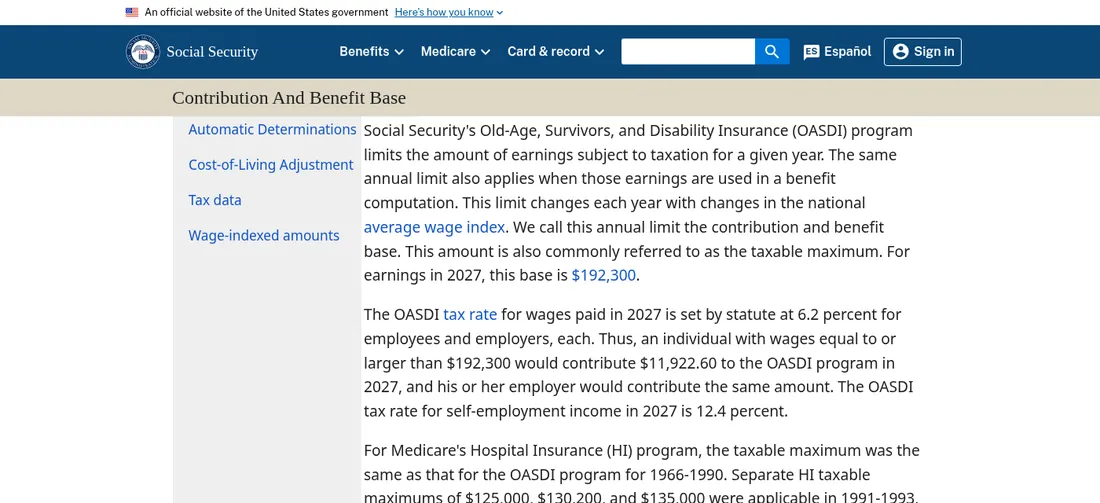
You owe it once your net self-employment earnings reach $400[1]. The 12.4% Social Security part stops at $184,500 of earnings in 2026 ($192,300 in 2027), while the 2.9% Medicare part has no cap[2][4]. The one consolation is that you deduct half of it when figuring adjusted gross income[1].
In real money: $60,000 of net profit means about $8,478 in self-employment tax for 2026, before you've paid a cent of income tax. That's roughly $707 a month you shouldn't treat as yours.
This is general information from IRS and SSA sources, not personal tax advice. Rules have exceptions (church employees, ministers, farm income, non-calendar tax years). Check with a CPA or enrolled agent for your situation.
What is self-employment tax?
It's Social Security and Medicare tax for people who work for themselves. The IRS describes it as similar to the Social Security and Medicare taxes withheld from most wage earners' pay[1]. The difference is that nobody's withholding it for you.
It's also completely separate from income tax. You can owe self-employment tax in a year when you owe no income tax at all. Age doesn't get you out of it either: the rules apply even if you already receive Social Security or Medicare[1].
You must pay it and file Schedule SE if your net earnings from self-employment are $400 or more[1][3]. Sole proprietors and independent contractors usually work out net profit on Schedule C first[1].
Employee vs self-employed: why it feels like double tax
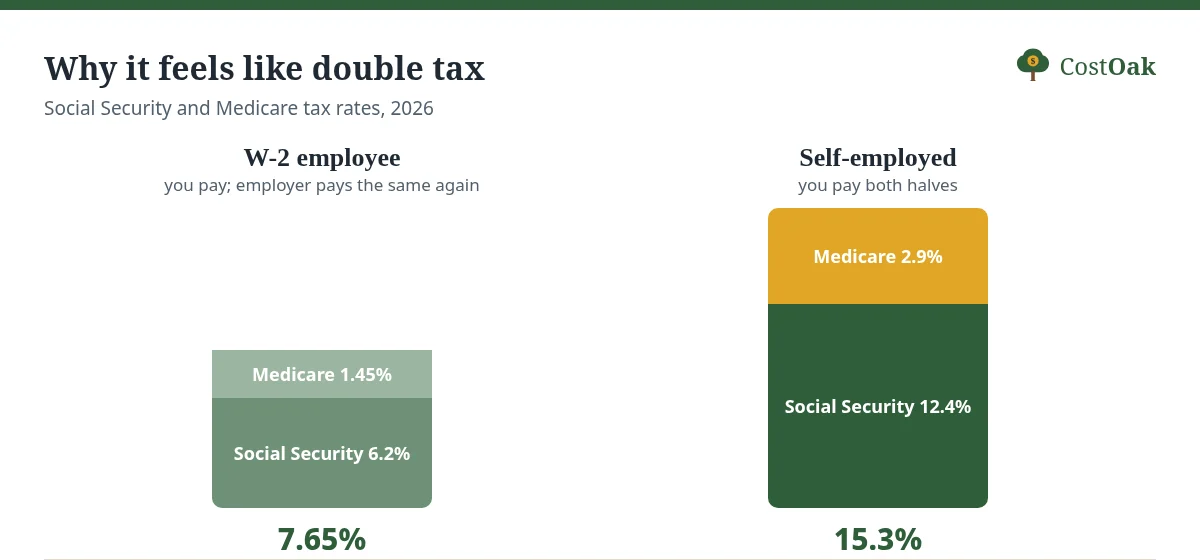
Ever wonder why your take-home feels thinner than it did on a salary? An employee pays 7.65% and their employer quietly pays another 7.65%. When you work for yourself, you're both of those people, so you pay both halves[4]:
| Employee (W-2) | Self-employed | |
|---|---|---|
| Social Security | 6.2% (employer pays another 6.2%) | 12.4% |
| Medicare | 1.45% (employer pays another 1.45%) | 2.9% |
| Total you pay | 7.65% | 15.3% on 92.35% of net profit |
| How it's paid | Withheld from each paycheck | Quarterly estimated payments, settled on Schedule SE |
| Deduction | None | Half of SE tax, deducted from income |
Flip it around and an employer pays its 7.65% half plus unemployment taxes and benefits. The Employee Cost Calculator adds up what a hire really costs.
How to calculate self-employment tax
The math is six steps, and none of them are hard:
- Start with net profit from Schedule C (income minus business expenses).
- Multiply by 92.35%. IRS Publication 334 calls this the regular method, and the result is your net earnings from self-employment (Schedule SE line 4a)[2].
- Apply 12.4% for Social Security to earnings up to $184,500 for 2026, minus any W-2 wages that already had Social Security tax withheld[2][1].
- Apply 2.9% for Medicare to all of it[1].
- Add the two. That's your SE tax, reported on Schedule 2 of Form 1040.
- Deduct half as an adjustment to income. It lowers your income tax, not your SE tax[1].
Earning well? You may also owe the 0.9% Additional Medicare Tax on wages and self-employment income above $200,000 (single or head of household), $250,000 (married filing jointly) or $125,000 (married filing separately)[1].

Worked examples for 2026
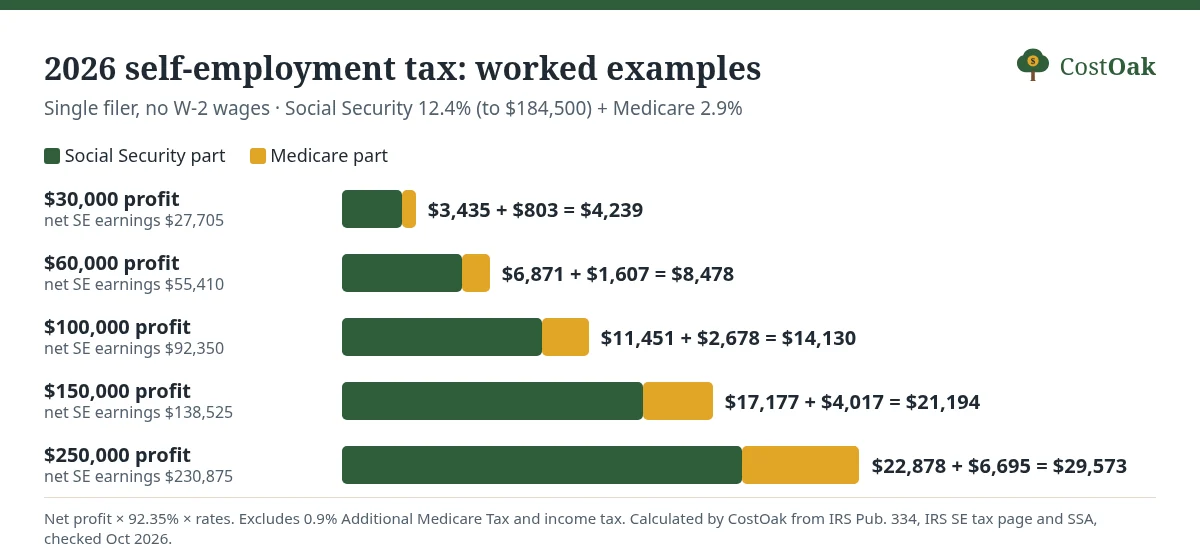
| Net profit (Schedule C) | × 92.35% = net SE earnings | Social Security 12.4% | Medicare 2.9% | SE tax | Deductible half | Effective rate on profit |
|---|---|---|---|---|---|---|
| $30,000 | $27,705 | $3,435 | $803 | $4,239 | $2,119 | 14.1% |
| $60,000 | $55,410 | $6,871 | $1,607 | $8,478 | $4,239 | 14.1% |
| $100,000 | $92,350 | $11,451 | $2,678 | $14,130 | $7,065 | 14.1% |
| $150,000 | $138,525 | $17,177 | $4,017 | $21,194 | $10,597 | 14.1% |
| $250,000 | $230,875 | $22,878 | $6,695 | $29,573 | $14,787 | 11.8% |
Notice the effective rate dropping at the top of the table? That's the wage base at work: the 12.4% part stops at $184,500. At $250,000 of profit, net SE earnings are $230,875. Social Security is capped at $22,878 and Medicare adds $6,695. A single filer would also owe about $278 of Additional Medicare Tax on the amount over $200,000.
If you're pricing your own work, build this in from day one. The Freelance Hourly Rate Calculator includes a tax set-aside.
How and when to pay
Because nobody withholds SE tax for you, you usually pay it through quarterly estimated tax payments along with your income tax[1]. For income earned in 2026, the IRS due dates are[5]:
- Jan 1–Mar 31: April 15, 2026
- Apr 1–May 31: June 15, 2026
- Jun 1–Aug 31: September 15, 2026
- Sep 1–Dec 31: January 15, 2027
Yes, the "quarters" are uneven. When a date falls on a weekend or holiday, it moves to the next business day. You then settle the year on Schedule SE with your Form 1040. You'll need a Social Security number or ITIN to pay SE tax[1].
Ways to lower it legally
The simplest lever is also the most boring one: track every business expense. SE tax is charged on net profit, so every legitimate deduction on Schedule C reduces it directly. Software subscriptions count, and you can see what a typical stack costs in the software-stack cost calculator.
If you buy your own health insurance, look at the self-employed health insurance deduction. The IRS notes it's taken into account when calculating net earnings from self-employment[1].
Then there's business structure. Some owners elect S-corp taxation and pay themselves a reasonable salary. It isn't free money, though. It brings its own payroll costs and rules, and it's a decision to make with a CPA, not off a blog post.
Pricing your work? See how to set a freelance hourly rate. Wondering whether to pay someone to file? Here's what tax preparation costs, and whether you need an EIN for your business. More guides on taxes, credit and costs are in the business finance hub, and our CRM price guide covers another common tool you can deduct.
Frequently asked questions
What is the self-employment tax rate for 2026?
15.3%: 12.4% for Social Security and 2.9% for Medicare, applied to 92.35% of net self-employment earnings. The Social Security part applies only to the first $184,500 of combined earnings in 2026 (checked Oct 2026).
Do I pay self-employment tax if I earn under $400?
No. You must pay SE tax and file Schedule SE when net earnings from self-employment are $400 or more. Special lower thresholds apply to church employee income.
How much self-employment tax will I pay on $50,000?
About $7,065 on $50,000 of net profit: $50,000 × 92.35% = $46,175, then × 15.3%. You can deduct half (about $3,532) when figuring adjusted gross income. Income tax is separate.
Is self-employment tax the same as income tax?
No. SE tax funds Social Security and Medicare and is figured on Schedule SE. Income tax is figured separately on Form 1040. You can owe SE tax even with no income tax due.
When do I pay self-employment tax?
Usually through quarterly estimated payments: April 15, June 15 and September 15 of the tax year and January 15 of the next year, then settled with your annual return. This is general information, not tax advice.
Sources
Rates and thresholds come from the IRS and the Social Security Administration, checked Oct 2026. Tax rules change; confirm on IRS.gov for the year you're filing. See our editorial policy, methodology and affiliate disclosure.
- [1] IRS: Self-employment tax (Social Security and Medicare taxes): https://www.irs.gov/businesses/small-businesses-self-employed/self-employment-tax-social-security-and-medicare-taxes (checked Oct 2026)
- [2] IRS Publication 334, Tax Guide for Small Business: https://www.irs.gov/publications/p334 (checked Oct 2026)
- [3] IRS: Instructions for Schedule SE (Form 1040): https://www.irs.gov/instructions/i1040sse (checked Oct 2026)
- [4] SSA: Contribution and benefit base: https://www.ssa.gov/oact/cola/cbb.html (checked Oct 2026)
- [5] IRS: Estimated tax FAQs: https://www.irs.gov/faqs/estimated-tax (checked Oct 2026)