How to set your freelance hourly rate (without guessing)
Quick answer
Don't divide a salary by 2,080. Work backward instead: take what you want to keep, gross it up for taxes, add your business costs, then divide by the hours you can actually bill in a year.
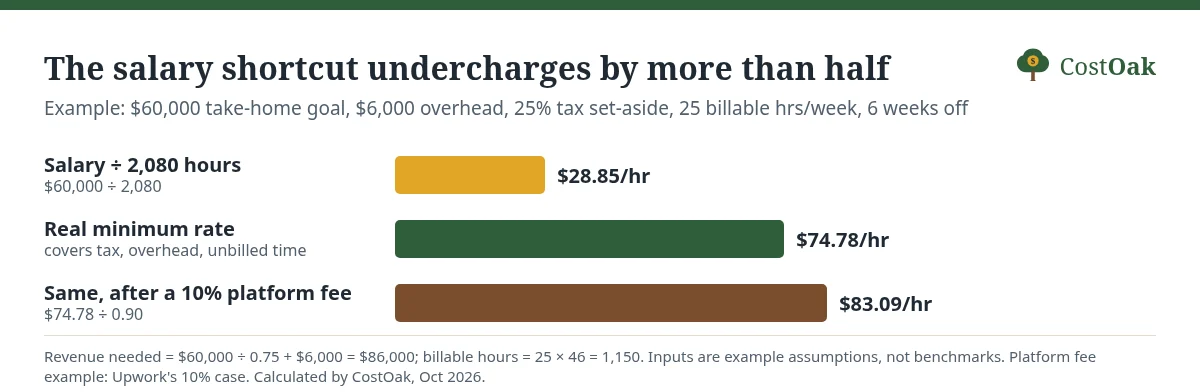
In our example, a $60,000 take-home goal works out to a minimum of about $75 an hour, not the $28.85 the salary shortcut suggests. Run your own numbers in the Freelance Hourly Rate Calculator. It takes about a minute.
The worked examples use made-up inputs to show the math. They aren't industry rate benchmarks. Tax set-asides vary by state and situation; a CPA or enrolled agent can help you pick yours.
Pricing yourself is weirdly emotional. Charge too much and you worry nobody will hire you. Charge too little and, six months in, you're working every weekend and still nervous about the tax bill.
Honestly, most people overthink the "what will clients pay" part and underthink the "what do I need" part. So let's start with what you need.
Why can't you just turn your salary into an hourly rate?
The classic salary-to-hourly trick is to divide an annual salary by 2,080, which is 40 hours × 52 weeks. It works fine for an employee. For a freelancer it quietly ignores three things your employer used to pay for.
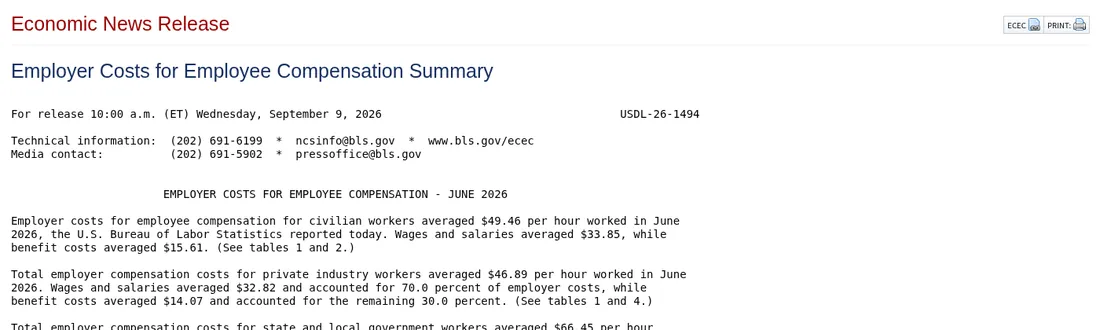
First, benefits and the employer's share of payroll taxes. The Bureau of Labor Statistics puts the average cost of a private-industry worker at $46.89 per hour worked in June 2026, and only $32.82 of that (70.0%) was wages. The other 30.0%, $14.07, went on benefits[1].
Put another way: if a job paid you $60,000, your employer was spending something like $85,700 on you all-in ($60,000 ÷ 0.70). That's a rough average-based estimate, not a rule. Still, it shows why the freelance number has to be bigger.
Second, you can't bill 2,080 hours. Nobody does. Admin, sales calls, invoicing and the inbox all eat time nobody pays for.
Third, you now pay both halves of Social Security and Medicare. Self-employment tax is 15.3% on 92.35% of your net earnings[2]. On $80,000 of profit that's $11,303.64, before income tax. (Our self-employment tax guide walks through it.)
How do you work out your hourly rate as a freelancer?
Here's the formula the calculator uses. Four inputs, no guesswork:
Minimum rate = (take-home ÷ (1 − tax set-aside) + overhead) ÷ (billable hours a week × working weeks)
Say you're Maya, a freelance designer (an example, not a real client). She wants to take home $60,000. She expects about $6,000 a year in overhead: software, a laptop fund, insurance, an accountant. She sets aside 25% of revenue for taxes. And she thinks 25 billable hours a week is realistic, with 6 weeks off for holidays, sick days and the inevitable slow August.
| Step | Formula | Example |
|---|---|---|
| Take-home goal | What you want to keep | $60,000 |
| Gross up for tax | Take-home ÷ (1 − tax set-aside) | $60,000 ÷ 0.75 = $80,000 |
| Add overhead | Software, insurance, equipment, accountant | $80,000 + $6,000 = $86,000 |
| Billable hours | Hours a week × (52 − weeks off) | 25 × 46 = 1,150 |
| Minimum rate | Revenue ÷ billable hours | $86,000 ÷ 1,150 = $74.78/hr |
| Platform fee (optional) | Rate ÷ (1 − fee) | $74.78 ÷ 0.90 = $83.09/hr |
So Maya's floor is $74.78 an hour. Call it $75. That's the minimum, the number below which she's slowly losing money compared with her goal. Her actual rate can (and probably should) sit above it.
Want to play with your own numbers? Open the Freelance Hourly Rate Calculator. It shows the day rate too.
How many billable hours should you plan for?
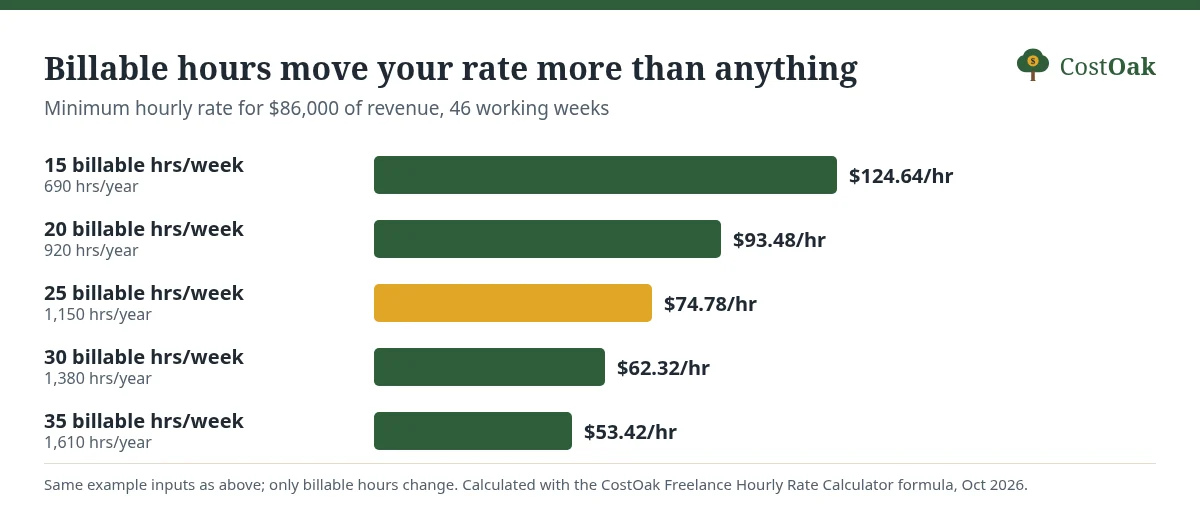
Fewer than you think. This is the input that moves everything.
| Billable hours a week | Billable hours a year (46 weeks) | Minimum hourly rate | Day rate (8 hrs) |
|---|---|---|---|
| 15 | 690 | $124.64 | $997 |
| 20 | 920 | $93.48 | $748 |
| 25 | 1,150 | $74.78 | $598 |
| 30 | 1,380 | $62.32 | $499 |
| 35 | 1,610 | $53.42 | $427 |
Look at the gap between 15 and 35 hours a week: $124.64 versus $53.42 for the exact same income goal. If you plan on 35 billable hours and actually manage 20, you'll end the year well short of $60,000. Not a fun discovery in December.
I'd start with a conservative guess, maybe 20 to 25 hours if you're new and still finding clients, then adjust once you've tracked a few months of real time. A simple time tracker (most invoicing tools have one) will tell you the truth fairly quickly.
And weeks off? Count holidays, sick days and the gaps between projects. Six weeks isn't lazy. It's realistic.
What should you set aside for taxes and overhead?
The 25% in our example is a placeholder, not advice. Your real number depends on your income, your state, your deductions and whether you have a spouse's income in the mix. The part everyone owes is the 15.3% self-employment tax on most of your profit[2], then federal income tax, then state tax where it applies.
The fear here is real: the letter from the IRS nobody wants, or a surprise bill in April. Setting the percentage a bit high and refunding yourself later is a lot less stressful than the reverse. If you expect to owe $1,000 or more, you'll generally need to pay quarterly estimates too[3]; the SE tax guide covers that.
Overhead is easier to pin down. List what you pay for: software subscriptions, equipment, insurance, a coworking desk, professional fees. If you're unsure what tools cost, our Software Stack Cost Calculator adds them up, and what a tax preparer costs is worth budgeting for.
Working through Upwork? Add the fee on top
Marketplaces take a cut of what you earn. Upwork's freelancer service fee ranges from 0% to 15% per contract, and it's fixed once the contract begins[4]. You see the percentage before you accept the job.
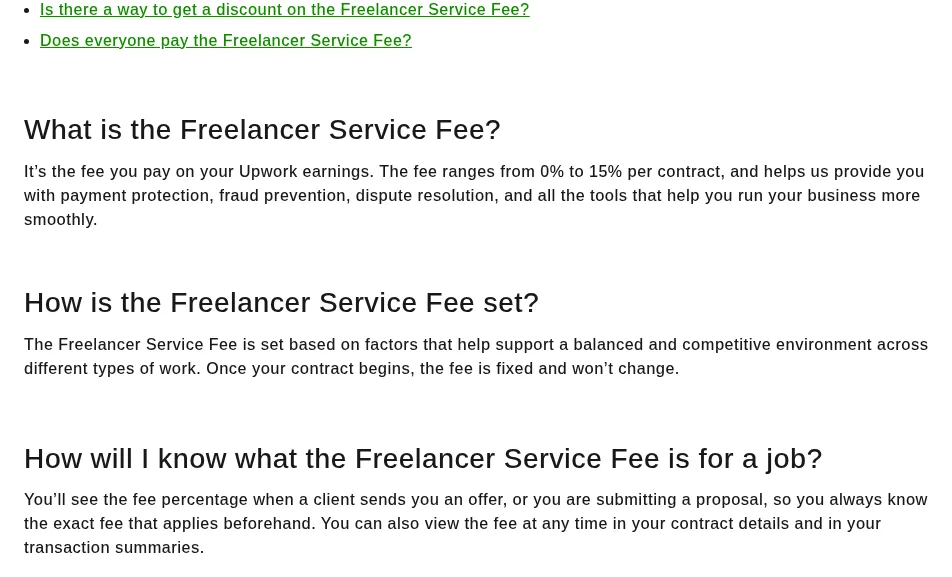
To keep your floor intact, divide by what's left after the fee, rather than just adding the percentage. At a 10% fee, Maya's $74.78 becomes $74.78 ÷ 0.90 = $83.09. (Adding 10% would give $82.26, which comes up a little short.)
Clients clearly keep coming back: Upwork holds a 4.2 TrustScore from 16,606 reviews on Trustpilot[5], and Trustpilot's AI summary says reviewers appreciate the secure payment system. Just make sure the fee is in your rate, not in your margin.
Card fees work the same way when clients pay invoices online. The Stripe and PayPal fee calculators show what you'd net, and our guide to credit card processing fees explains the rest.
Is your rate too high or too low for the market?
Once you know your floor, look outward. What are other freelancers in your niche quoting? What did your last few clients push back on, and what did they accept without blinking?
If your floor is well above what clients in your niche pay, the fix usually isn't charging less. It's changing an input: more billable hours through better client flow, lower overhead, or a more specialized offer that commands more.
If your floor is well below the going rate? Lucky you. Charge the market rate and enjoy the cushion.
A quick word on hourly versus project pricing. Plenty of freelancers quote per project or per day. That's fine, and often smarter. But you still need your hourly floor to sanity-check every quote: estimate the hours, multiply, then add a buffer for the revisions nobody mentions upfront.
When should you raise your freelance rate?
When you're consistently booked out. When your costs go up. When you've added a skill clients clearly value. Or, simplest of all, once a year.
New clients get the new rate straight away. For existing ones, a heads-up of a month or so, with the new number and the date it starts, is the usual courtesy. Most good clients expect it.
And rerun the calculator whenever your inputs change. A new laptop, a move to a pricier state, a baby on the way: all of those shift the floor.
Frequently asked questions
How do I convert a salary to a freelance hourly rate?
Don't divide by 2,080. Start with the take-home you want, divide by (1 − your tax set-aside), add yearly overhead, then divide by billable hours (hours a week × working weeks). A $60,000 take-home goal with $6,000 overhead, 25% set-aside and 25 billable hours over 46 weeks gives about $74.78 an hour. The Freelance Hourly Rate Calculator does it for you.
How many billable hours does a freelancer have per year?
It depends on your work, but it's far fewer than 2,080. Admin, sales and gaps between projects eat time. Many freelancers plan on 20 to 30 billable hours a week. Track your real hours for a few months and use those.
Should my freelance rate be higher than my old hourly wage?
Usually much higher. You now pay for your own benefits, both halves of Social Security and Medicare (15.3% self-employment tax on 92.35% of net earnings), your tools, and all the hours you can't bill. BLS data shows benefits make up about 30% of what private employers spend per hour worked.
How do I account for Upwork fees in my rate?
Divide your minimum rate by (1 − the fee). Upwork's freelancer fee ranges from 0% to 15% per contract (checked Oct 2026), so at 10% a $74.78 floor becomes $83.09.
What should I set aside for taxes as a freelancer?
It varies with income, state and deductions. Everyone with net self-employment earnings of $400 or more owes the 15.3% self-employment tax on most of their profit, plus income tax. Ask a CPA or enrolled agent for a percentage that fits your situation.
Should I charge hourly or per project?
Either works. Per-project or day rates often earn more for efficient work, but you still need your hourly floor to check that each quote covers the hours it will take.
Sources
Rates in the examples are calculated from stated example inputs with the CostOak calculator formula. Supporting figures come from the sources below, checked Oct 2026. See our editorial policy, methodology and affiliate disclosure.
- [1] US Bureau of Labor Statistics: Employer Costs for Employee Compensation, June 2026 (news release): https://www.bls.gov/news.release/ecec.nr0.htm (checked Oct 2026)
- [2] IRS: Self-employment tax (Social Security and Medicare taxes): https://www.irs.gov/businesses/small-businesses-self-employed/self-employment-tax-social-security-and-medicare-taxes (checked Oct 2026)
- [3] IRS: Estimated tax FAQs: https://www.irs.gov/faqs/estimated-tax (checked Oct 2026)
- [4] Upwork Help: Learn about the Freelancer Service Fee: https://support.upwork.com/hc/en-us/articles/211062538-Learn-about-the-Freelancer-Service-Fee (checked Oct 2026)
- [5] Trustpilot: Upwork reviews page: https://www.trustpilot.com/review/upwork.com (checked Oct 2026)