Credit card processing fees for small business (and how to lower them)
Quick answer
Most small businesses pay roughly 2.3% to 3.5% plus a fixed fee of 5¢ to 49¢ per card payment on the big flat-rate processors. In person is usually cheaper (Square from 2.4% to 2.6% + 15¢, Stripe Terminal 2.7% + 5¢); online and invoices cost more (Stripe 2.9% + 30¢, PayPal Checkout 3.49% + 49¢)[4][1][2].
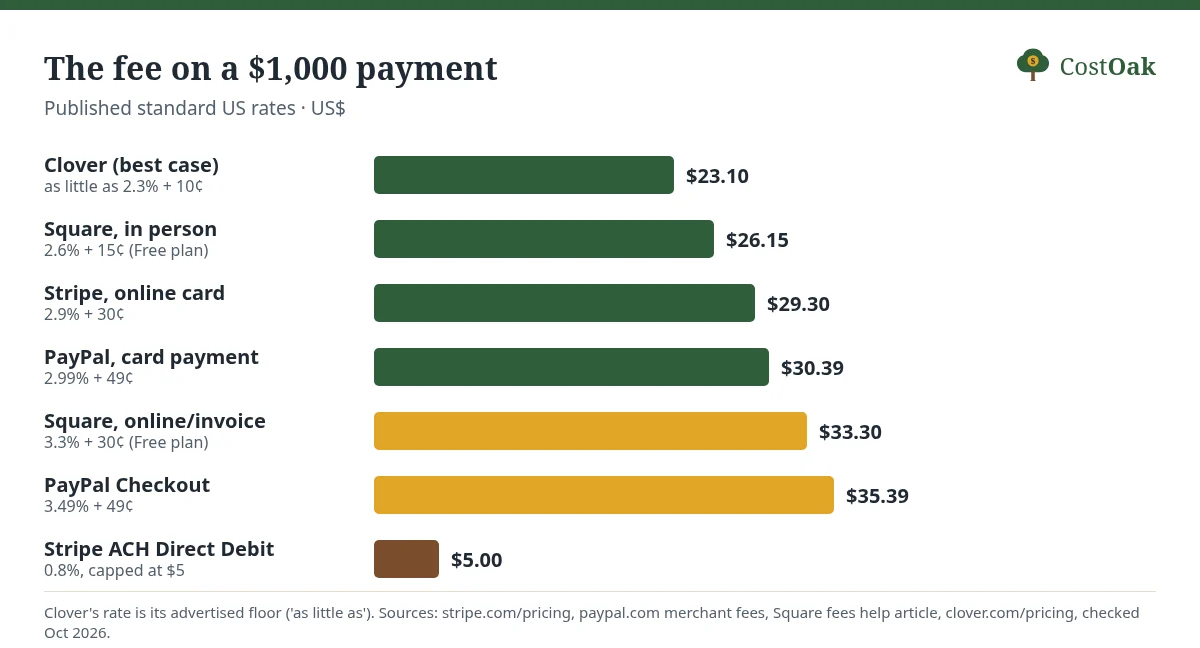
On $1,000 that's about $23 to $35. To check your own numbers, try the Stripe Fee Calculator or the PayPal Fee Calculator.
Card fees are the tax nobody votes for. They come off the top of every sale, they're described in a language that seems designed to confuse ("interchange," "assessments," "MDR"), and they quietly add up to one of your bigger monthly costs.
Let's make them make sense.
Where do credit card processing fees actually go?
When a customer taps a card, a few parties get a slice. The card-issuing bank gets an interchange fee. The card network (Visa, Mastercard and so on) gets its own fees. And the company that handles the payment for you, often called the acquirer or processor, takes its cut.
You usually don't pay those parties separately. Visa says merchants don't pay interchange directly; they pay a "merchant discount" to their financial institution, typically a percentage per transaction[9]. Mastercard describes interchange as one component of the merchant discount rate that acquirers set[10].
So your bill is a bundle. How the bundle is priced is what you can actually shop on.
A peek inside the bundle: debit cards
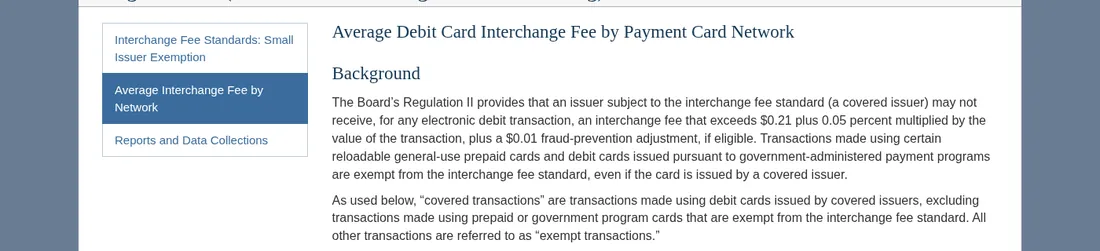
Debit is the clearest example, because the Federal Reserve publishes the data. For large banks (those with $10 billion or more in assets), Regulation II caps debit interchange at 21¢ plus 0.05% of the sale, plus a 1¢ fraud-prevention adjustment if eligible[7]. In 2024, regulated debit transactions averaged $48.95 with 23¢ of interchange, about 0.47%. Debit from smaller, exempt banks averaged 51¢ on a $42.27 sale[7].
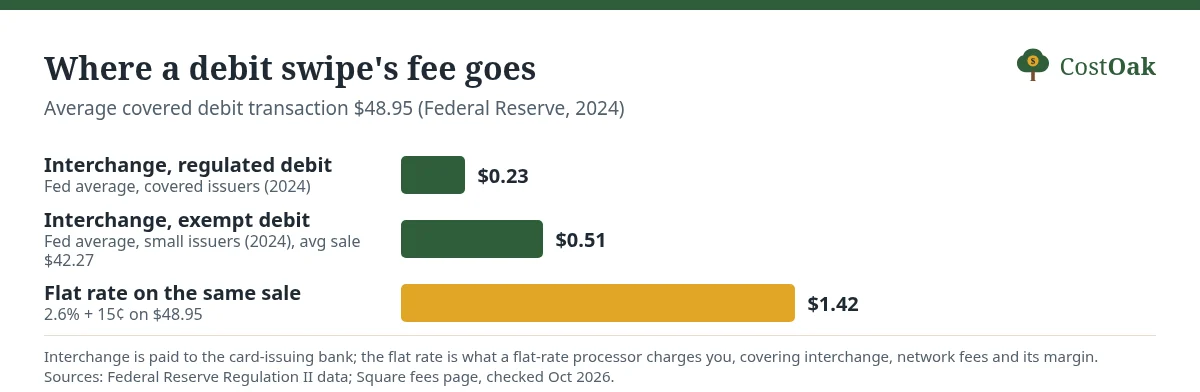
Compare that with a flat 2.6% + 15¢ on the same $48.95 sale: $1.42. The gap pays for network fees, the processor's costs and its margin, plus the convenience of a simple, predictable rate. That's not a scandal. But it does show where there's room to negotiate once you're processing serious volume.
(The Fed has also proposed lowering the debit cap. As of Oct 2026 that was a proposal, not a rule[8].)
What do Stripe, PayPal, Square, Clover and Helcim charge?
| Provider | In person | Online / invoice | Extras to know |
|---|---|---|---|
| Stripe | 2.7% + 5¢ (Terminal) | 2.9% + 30¢ | +0.5% manually entered, +1.5% international cards, +1% currency conversion; ACH 0.8% capped at $5; $15 dispute fee |
| PayPal | QR code: 2.29% + 9¢ | Cards 2.99% + 49¢; PayPal Checkout 3.49% + 49¢ | Venmo 3.49% + 49¢; Pay Later 4.99% + 49¢; +1.5% international |
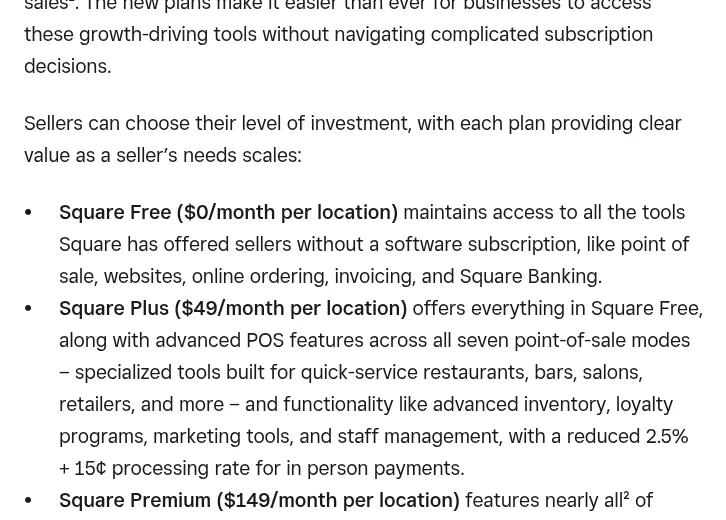
| Square | 2.6% / 2.5% / 2.4% + 15¢ (Free / Plus / Premium) | 3.3% + 30¢ (Free); 2.9% + 30¢ (Plus, Premium) | Keyed-in 3.5% + 15¢; paid plans $49 or $149 per location a month |
| Clover | As little as 2.3% + 10¢ | Varies | Advertised floor; get your actual rate in writing |
| Helcim | Interchange-plus | Interchange-plus | $0 monthly fee; $15 for chargebacks you lose |
A few things jump out. In person is cheaper than online almost everywhere, largely because card-present payments are generally seen as lower-risk. PayPal's 49¢ fixed fee is steep on small sales: on a $10 payment it's nearly 5% on its own. And the extras matter: Stripe adds 0.5% for manually entered cards and 1.5% for international ones[1].

Square's paid plans lower the in-person rate. Plus ($49 per location a month) drops it to 2.5% + 15¢ and Premium ($149) to 2.4% + 15¢[4]. That only pays off at high volume: around $49,000 a month in card sales for Plus, on the rate saving alone. Our POS system cost guide runs those numbers.
So what do card fees cost a small business per month?
Say you're a dog groomer doing $8,000 a month in card payments (an example), about 100 appointments at $80 each.
| How you take payment | Rate | Per month | Per year |
|---|---|---|---|
| Clover (advertised floor) | 2.3% + 10¢ | $194 | $2,328 |
| Stripe Terminal | 2.7% + 5¢ | $221 | $2,652 |
| Square Free, in person | 2.6% + 15¢ | $223 | $2,676 |
| Stripe online card / invoice | 2.9% + 30¢ | $262 | $3,144 |
| PayPal card payment | 2.99% + 49¢ | $288.20 | $3,458.40 |
| Square Free, online / invoice | 3.3% + 30¢ | $294 | $3,528 |
Taking payment in person on Square's free plan costs about $223 a month, or $2,676 a year. Send every client a PayPal invoice instead, and it's about $288 a month. Same revenue, about $780 more a year in fees.
Honestly, that's the single biggest lever most small businesses have. Not switching providers. Just steering payments toward the cheaper method.
Freelancers billing by invoice can do even better with bank payments. Stripe's ACH Direct Debit is 0.8%, capped at $5[1], so a $1,000 invoice costs $5 instead of $29.30 by card. The Stripe Fee Calculator shows both. And if you're setting your rates, build fees into them: here's how to set a freelance hourly rate.
Flat-rate or interchange-plus: which is cheaper?
Flat-rate pricing (Square, Stripe's standard pricing, PayPal) charges one advertised rate whatever card the customer uses. Simple. Predictable. Usually not the cheapest at scale.
Interchange-plus passes the actual interchange through and adds a fixed markup. Helcim uses it by default, with no monthly fee[6], and Stripe offers "IC+" as part of custom pricing for larger businesses[1]. Because debit and many everyday cards carry lower interchange, interchange-plus can come out cheaper. The trade-off is a statement that's harder to read and fees that vary month to month.
My rule of thumb: if your card volume is small, the simplicity of flat-rate is worth a little extra. Once it's big enough that a 0.3% difference is real money each month, get an interchange-plus quote and compare.
How can you lower your credit card processing fees?
Some ideas, roughly in order of effort:
Take cards in person when you can. Square's in-person rate is 2.6% + 15¢ against 3.3% + 30¢ online on its free plan[4]. Keyed-in card numbers are pricier still at 3.5% + 15¢[3].
Offer bank payments for big invoices. ACH is far cheaper on large amounts, as the Stripe example shows.
Watch the fixed fee if your sales are small. A café with $6 average sales should care more about the 10¢ vs 30¢ than the 2.6% vs 2.9%.
Avoid unnecessary chargebacks. Stripe charges $15 per dispute[1], and Helcim $15 for disputes you lose[6]. Clear receipts and a recognizable business name on card statements help.
Ask. Square mentions custom pricing for businesses processing over $250,000 a year[4], and Stripe advertises volume discounts on custom plans[1]. Nobody hands you a discount you don't ask for.
Can you pass card fees on to customers?
Sometimes, with rules. Visa, for example, says merchants must notify their acquirer 30 days before they start surcharging[9], and other network rules and state laws apply on top.
A simpler route many small businesses take: a cash or bank-transfer discount, or building expected fees into their prices. Talk to your processor before adding any surcharge.
What do businesses complain about with payment processors?
Rates are only half the story. The other half is what happens when something goes wrong.
Stripe holds a 1.6 TrustScore from 17,549 Trustpilot reviews, and Trustpilot's AI summary says reviewers frequently report accounts being restricted and funds held[11]. PayPal sits at 1.4 from 41,952 reviews, with complaints about account freezes and slow dispute resolution[12]. Helcim scores 4.0 from 1,102 reviews, with reviewers praising its support[13].
Review sites skew negative, and the giants process huge numbers of payments. Still, it's worth keeping a few weeks of cash in reserve so a held payout doesn't become a crisis. A business line of credit can be a backup too.
Fees are a cost of doing business, like your software stack. Know the number, steer toward the cheaper payment methods, and revisit it once a year.
Frequently asked questions
What are typical credit card processing fees for a small business?
On popular flat-rate processors, about 2.3% to 3.5% plus 5¢ to 49¢ per transaction (checked Oct 2026). Square charges 2.6% + 15¢ in person on its free plan; Stripe charges 2.9% + 30¢ online; PayPal charges 2.99% + 49¢ for card payments and 3.49% + 49¢ for PayPal Checkout.
How much is the fee on a $1,000 card payment?
At published rates: about $23.10 on Clover's advertised floor, $26.15 with Square in person, $29.30 on Stripe online, $30.39 for a PayPal card payment and $35.39 with PayPal Checkout. Stripe's ACH Direct Debit would cost $5.
Is Stripe or PayPal cheaper?
For a standard online card payment, Stripe (2.9% + 30¢) is cheaper than PayPal (2.99% + 49¢ for cards, 3.49% + 49¢ for PayPal Checkout). Use the Stripe and PayPal fee calculators to compare your amounts.
What is interchange-plus pricing?
You pay the card's actual interchange fee plus a fixed markup, instead of one flat rate. It can be cheaper, especially with lots of debit cards, but monthly statements are harder to read. Helcim uses it by default; Stripe offers it on custom pricing.
Why is online card processing more expensive?
Processors generally treat online and keyed-in payments as riskier than card-present ones and price them higher. Square, for example, charges 2.6% + 15¢ in person on its free plan but 3.3% + 30¢ online.
Can I charge customers a fee for paying by card?
Sometimes. Card networks allow credit card surcharges with conditions (Visa requires notifying your acquirer 30 days ahead), and state rules vary. Check with your processor first.
Sources
Rates come from each processor's US pricing page; interchange data from the Federal Reserve; network rules from Visa and Mastercard; review figures from Trustpilot, checked Oct 2026. See our editorial policy, methodology and affiliate disclosure.
- [1] Stripe pricing (US): https://stripe.com/pricing (checked Oct 2026)
- [2] PayPal merchant fees (US): https://www.paypal.com/us/business/paypal-business-fees (checked Oct 2026)
- [3] Square Support: What are Square's fees?: https://squareup.com/help/us/en/article/5068-what-are-square-s-fees (checked Oct 2026)
- [4] Square press release: unified pricing and packaging: https://squareup.com/us/en/press/unified-pricing-and-packaging (checked Oct 2026)
- [5] Clover pricing: https://www.clover.com/pricing (checked Oct 2026)
- [6] Helcim pricing: https://www.helcim.com/pricing/ (checked Oct 2026)
- [7] Federal Reserve: Regulation II, average debit card interchange fee by network (2024 data): https://www.federalreserve.gov/paymentsystems/regii-average-interchange-fee.htm (checked Oct 2026)
- [8] Federal Reserve: Regulation II overview (incl. proposal to lower the cap): https://www.federalreserve.gov/paymentsystems/regii-about.htm (checked Oct 2026)
- [9] Visa: Regulation and fees (merchant information): https://www.visa.com/en-us/support/business/regulation-fees (checked Oct 2026)
- [10] Mastercard: Merchant interchange rates: https://www.mastercard.com/us/en/business/support/merchant-interchange-rates.html (checked Oct 2026)
- [11] Trustpilot: Stripe reviews page: https://www.trustpilot.com/review/stripe.com (checked Oct 2026)
- [12] Trustpilot: PayPal reviews page: https://www.trustpilot.com/review/www.paypal.com (checked Oct 2026)
- [13] Trustpilot: Helcim reviews page: https://www.trustpilot.com/review/helcim.com (checked Oct 2026)