Business line of credit: what it costs, who qualifies and the alternatives
Quick answer
A business line of credit lets you draw cash up to a limit, pay interest only on what you draw, and borrow again as you repay. Simple enough. The part that catches people out is the price, which depends far more on where you borrow than on the product itself. Here's what we found when we checked[1][2][3][4].
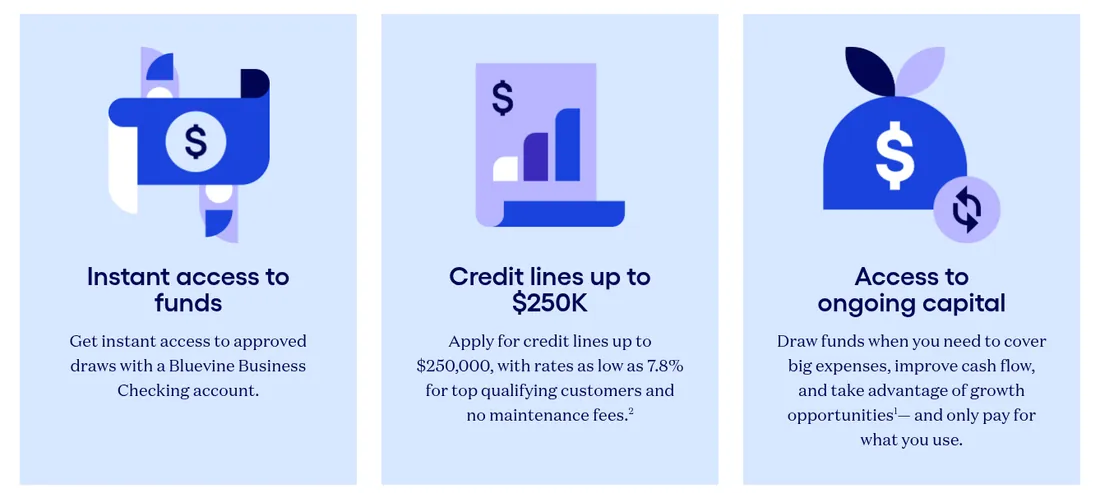
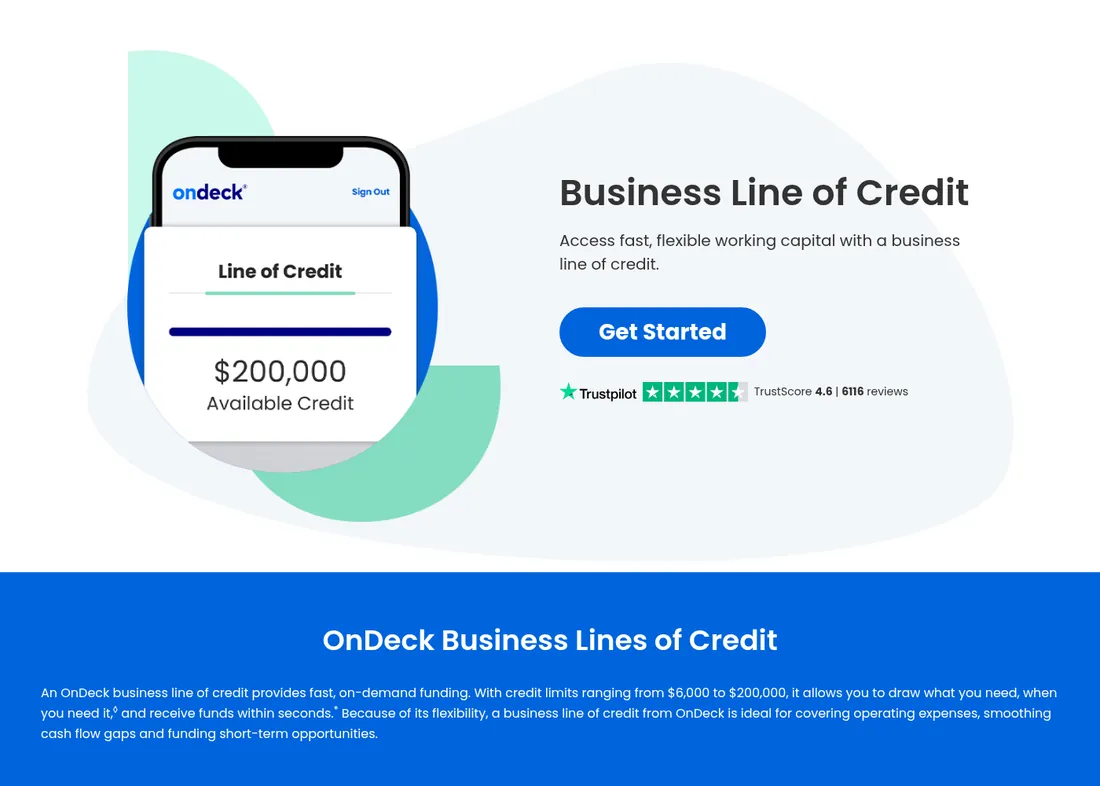
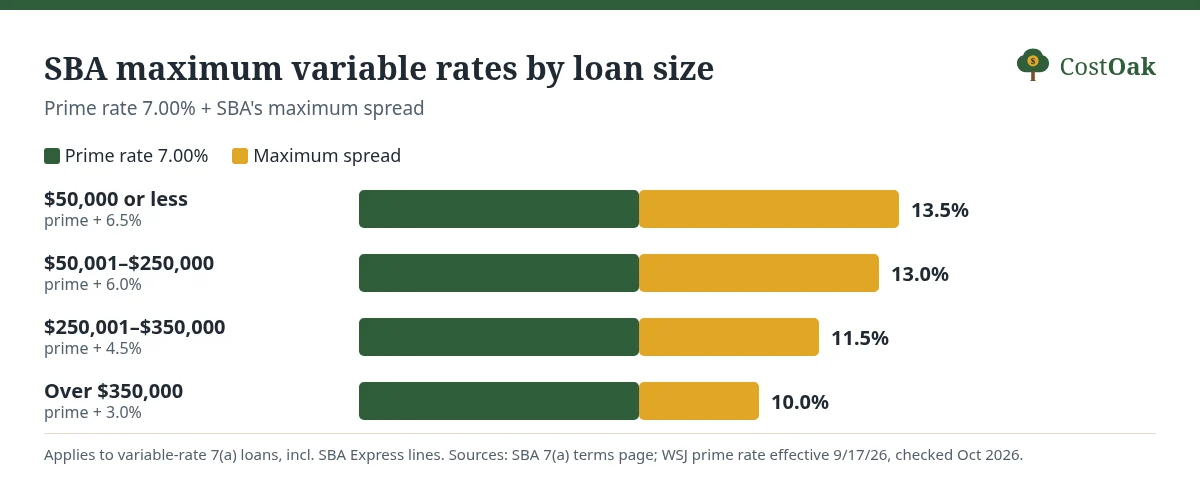
Bank lines under the SBA Express program carry variable rates capped at prime + 3% to prime + 6.5%, which is 10.0%–13.5% with prime at 7.00%. Bluevine advertises rates "as low as 7.8%" for top-qualifying customers, on lines up to $250,000. OnDeck offers lines of $6,000–$200,000 with an average 59.8% APR on lines originated in the half-year to June 30, 2026.
What does that mean in dollars? On a $10,000 draw repaid over 12 months, it's the difference between roughly $430 and $3,500 in borrowing costs. Same product, eight times the price.
This is general information from lender disclosures and SBA program rules, not financial advice. CostOak earns no commission on any link on this page. Rates and eligibility change; read your offer's APR and fee disclosure before you sign.
How a business line of credit works
You're approved for a credit limit. You draw what you need, the money lands in your business checking account, and you repay each draw on a schedule. As you repay, the available credit refills, so you can draw again without reapplying[1][2]. Compare that with a term loan, which pays out one lump sum and charges interest on all of it from day one[2].
Lines can be secured, meaning backed by collateral such as receivables, inventory or equipment, which is usually cheaper. Or they can be unsecured: no collateral, but typically a personal guarantee and higher rates[2]. Online lines often behave more like a string of short loans than a credit card. OnDeck repays each draw over 12, 18 or 24 months, and Bluevine on a weekly or monthly plan[2][1].
Business line of credit lenders compared
| Tool | Starting price | Renewal price | Free plan / trial | Key limits | Best for | Our verdict | |
|---|---|---|---|---|---|---|---|
| Bluevine | Rates from 7.8% (top-qualifying) | Revolving; repay weekly or monthly | No maintenance fees; $15 wire or free ACH draw | Up to $250K; $10K monthly revenue, 625+ FICO, 12+ months, corp/LLC only | Established LLCs and corporations | Lowest advertised floor of the online lenders | Visit Bluevine |
| OnDeck | Average 59.8% APR (H1 2026) | 12, 18 or 24-month repayment per draw | No annual, monthly or draw fees | $6K–$200K; $100K annual revenue, 625 FICO, 1 year; $1,000 minimum first draw | Fast access when banks say no | Expensive on average; compare first | Visit OnDeck |
| SBA Express line (via banks) | Max prime + 6.5% on ≤$50K (13.5% at 7.00% prime) | Revolving up to 10 years | Lender fees vary | Up to $500K; SBA eligibility and lender underwriting | Bankable businesses that can wait | Cheapest ceiling, slowest route | Visit SBA Express line (via banks) |
What a line of credit really costs
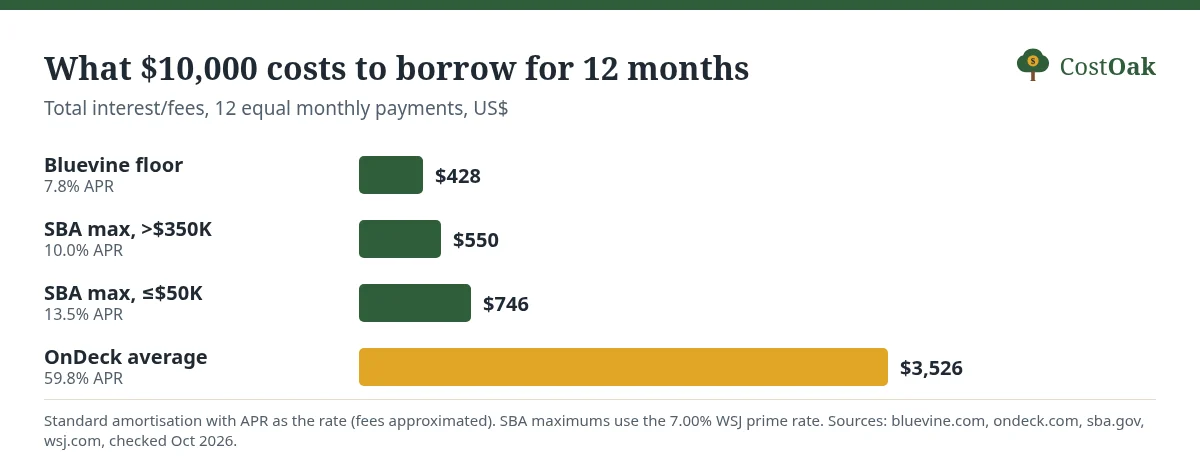
Three things set the price: the rate (or APR), the fees, and how long each draw stays out. Here's what a $10,000 draw repaid over 12 months would cost at four published rate points:
| Rate scenario | APR | Monthly payment | Total cost of borrowing |
|---|---|---|---|
| Bluevine advertised floor | 7.8% | $869 | $428 |
| SBA max, loans over $350K (prime + 3.0%) | 10.0% | $879 | $550 |
| SBA max, loans ≤ $50K (prime + 6.5%) | 13.5% | $896 | $746 |
| OnDeck average line of credit | 59.8% | $1,127 | $3,526 |
Look at the bottom row. At OnDeck's average APR, the same $10,000 costs about $3,526 to borrow for a year, against about $428 at Bluevine's advertised floor. That's not a rounding difference.
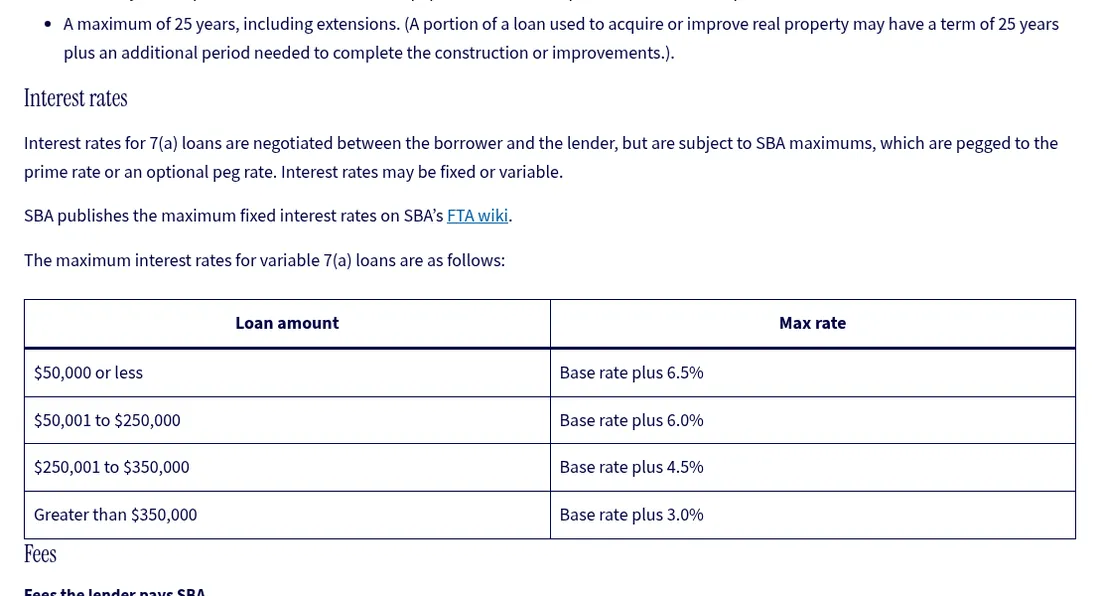
So why such a range? SBA rates are capped by regulation. For variable-rate 7(a) loans, the maximum is the base rate plus 6.5% for $50,000 or less, plus 6.0% for $50,001–$250,000, plus 4.5% for $250,001–$350,000 and plus 3.0% above $350,000[3]. With the WSJ prime rate at 7.00% (effective 9/17/26)[4], that's a ceiling of 10.0%–13.5%.
Online lenders aren't capped that way. OnDeck states its lowest rates go only to businesses with the strongest credit and cash flows, and discloses averages of 59.8% APR for lines and 53.2% for term loans[2]. Bluevine says the lowest rates go to applicants with the strongest profiles, and that "additional fees apply"[1]. Keep in mind that 7.8% is a floor, not a typical offer.

Fees to look for: draw fees, maintenance or annual fees, wire fees and origination fees. OnDeck says it charges no annual, monthly or draw fees and no prepayment penalty on lines[2]. Bluevine advertises no maintenance fees and charges $15 for a same-day wire draw to an external bank. ACH is free[1], so unless you need the money today, take the ACH.
Requirements to qualify
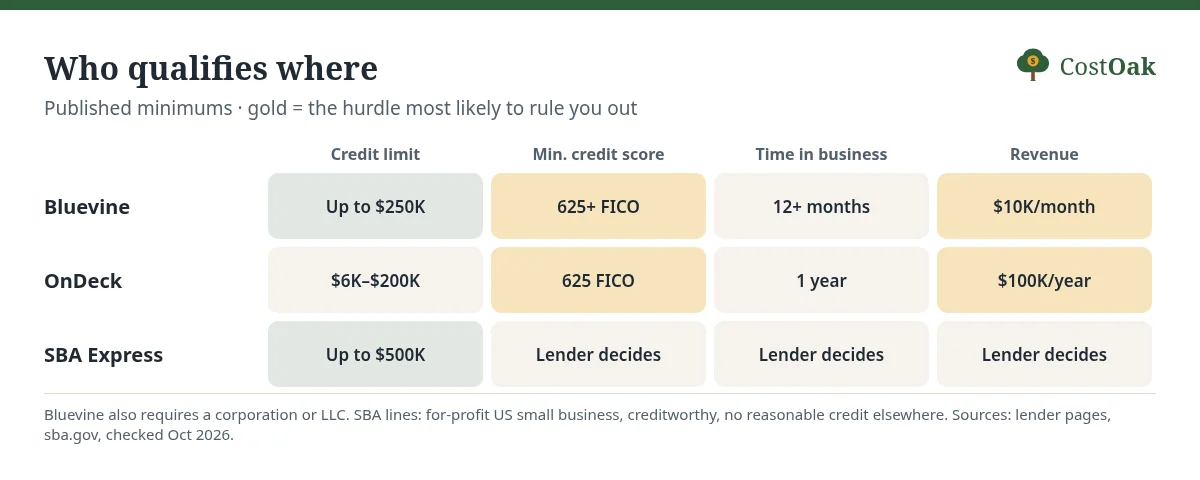
Bluevine wants $10,000 in monthly revenue, a 625+ personal FICO, 12+ months in business, and a corporation or LLC. Sole proprietors can't get a Bluevine line. You also need no bankruptcies, and it doesn't lend in Nevada, North Dakota or South Dakota[1].
OnDeck asks for 1 year in business, a business checking account, $100,000 in annual revenue and a 625 personal FICO. It doesn't lend in North Dakota[2].
SBA lines come with more conditions. Revolving credit is allowed only under SBA Express, Export Express and CAPLines[3]. You must be a for-profit US business that's small under SBA size standards, creditworthy, and unable to get the credit on reasonable terms elsewhere[3]. SBA Express lines go up to $500,000 and can revolve for up to 10 years, and lenders don't have to take collateral on loans up to $50,000[3].
Worried about your score? Both online lenders say applying uses a soft credit check. Bluevine notes that accepting an offer may result in a hard inquiry[1][2].
Weighing a lump-sum term loan instead? The Business Loan Calculator shows the payment, total interest and the APR once origination fees are counted, so you can compare it with a line's cost.
Alternatives to compare
A line of credit isn't always the right tool. A business credit card is fine for small, short purchases you can clear each month. A term loan suits a one-off purchase with a known cost, such as equipment[2]. And an SBA Microloan offers up to $50,000 from nonprofit intermediaries, repaid within 6 years[3].
Before you borrow at all, ask one blunt question: is the real problem that clients pay late? If so, collecting sooner beats borrowing on cost. Automated reminders and card or ACH payment links help.
Before you sign: a checklist
Get the APR, not just a rate or factor, plus the full fee schedule. A rate without fees is half the story. Check the repayment schedule for each draw, because weekly payments hit cash flow harder than monthly ones. Ask about prepayment: can you repay early and save interest?
Read the personal guarantee, and find out what's reported to credit bureaus. And compare at least one bank or SBA lender with one online lender before you decide. If an SBA lender says yes, your rate can't exceed the SBA maximum. If it says no, at least you'll know what the alternative costs.
More on the costs of running a small business: our business finance hub, cost guides, the Small-Business Software Stack Cost Calculator, the Break-Even Calculator and our CRM price guide.
Frequently asked questions
How much does a business line of credit cost?
It ranges widely. SBA Express bank lines are capped at prime + 3% to prime + 6.5% (10.0%–13.5% with prime at 7.00%). Bluevine advertises rates from 7.8% for top applicants. OnDeck discloses an average 59.8% APR on lines (checked Oct 2026).
What credit score do I need for a business line of credit?
Bluevine and OnDeck both list a 625 personal FICO score as a minimum, plus time in business and revenue requirements (checked Oct 2026). Banks and SBA lenders set their own standards.
Can a sole proprietor get a business line of credit?
Some lenders accept sole proprietors, but not all. Bluevine says sole proprietorships can't qualify for a Bluevine Line of Credit, although checking customers may see partner offers. OnDeck lists time in business, revenue and credit score requirements.
Is a line of credit better than a business loan?
For recurring or unpredictable needs, a line is usually cheaper because you pay interest only on what you draw. For one large purchase with a fixed cost, a term loan is often simpler. This is general information, not financial advice.
Does the SBA offer lines of credit?
Yes, through lenders. Revolving lines are allowed under SBA Express (up to $500,000), Export Express and CAPLines, with interest rates capped at SBA maximums.
Sources
Rates, limits and requirements come from each lender's own page and the SBA, checked Oct 2026. Your offer depends on your credit profile; read the lender's disclosure before you sign. See our editorial policy, methodology and affiliate disclosure.
- [1] Bluevine Line of Credit (incl. FAQ and footnotes): https://www.bluevine.com/line-of-credit (checked Oct 2026)
- [2] OnDeck business line of credit (incl. disclosures): https://www.ondeck.com/line-of-credit (checked Oct 2026)
- [3] SBA: 7(a) terms, conditions and eligibility (incl. SBA Express, CAPLines, max rates): https://www.sba.gov/partners/lenders/7a-loan-program/terms-conditions-eligibility (checked Oct 2026)
- [4] WSJ money rates: U.S. prime rate: https://www.wsj.com/market-data/bonds/moneyrates (checked Oct 2026)